What Lives Inside an Emerald
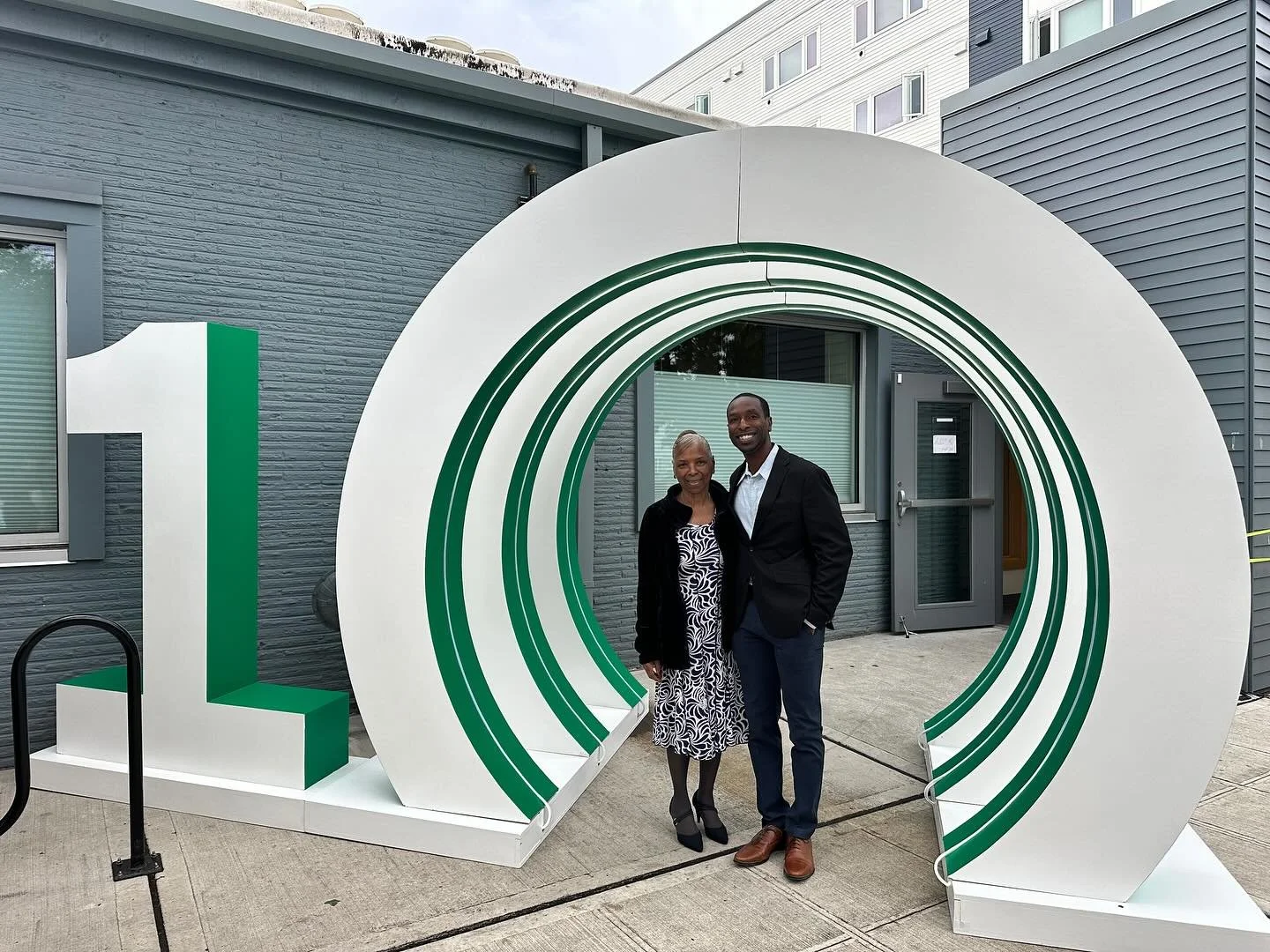
Mama Green and I at the Emerald’s 10th anniversary gala.
Twelve years ago, my mother Cynthia and I sat together at a dining room table, the kind of table that has witnessed a thousand ordinary family arguments, a thousand ordinary meals, and we were trying to build something that the city of Seattle had long decided our community did not deserve: a story told in full.
South Seattle had stories, of course. They just weren't ours. They were the ones written about us, the quick dispatch filed on deadline, the crime brief that never asked why, the feature that arrived in our neighborhood like a tourist and left without understanding what it had seen. The media had decided, as it so often does with Black communities and working-class communities of color, that the fast story ( the story that decomposes almost as soon as you finish reading it) was sufficient. That we were a problem to be documented, not a people to be known.
So we started the South Seattle Emerald.
I had left a career in investment. My father Phillip kept the lights on financially, and my mother stayed up most nights transcribing, editing, and proofreading. She was a 68-year-old woman showing up alongside her son to press conferences and protests, handing out business cards we'd printed at Kinko's. People laughed and told us it was foolish, that it would never survive, that no one would care about a community outlet focused on the beauty and complexity of a place the rest of the city had already written off. What will you have in a decade? Someone asked, meaning nothing.
What we have is this: twelve years of full stories. The story of Bill Austin, who spent years fighting for his wrongly incarcerated son Nathan while every other outlet dismissed him as just another Black man with a drug addiction, unworthy of the full weight of a human narrative. The story of Michael Flowers, murdered in a home invasion, whose dignity was stripped from him again by a 445-word article that left readers with nothing but his criminal record, dangling at the end like a verdict. His mother Mary read our story about Michael for years after he was gone, because we were the only ones who gave him back to himself.
These were not small acts. This is what I need you to understand. There is a philosophy at work in how we tell stories, and there is an opposing philosophy at work in how the powerful prefer to have them told. Brown Professor Tricia Rose put it plainly: this is not capitalism in the ordinary sense. This is media oligarchy: corporations and billionaires moving quietly to control not just the outlets but the entire mechanism of information, of perception, of what we are allowed to imagine about ourselves and about one another. The result is a media ecosystem that flattens us, and produces what my colleague once described as the single story, the one that teaches a young man in South Seattle to believe there is nothing worth celebrating about where he comes from, because that is all they ever said about him.
The Emerald was built as an argument against that. It was built on the principle that independence from corporate interest is not a luxury but the very condition of truth-telling. When you are not brought to your readers by the people who profit from their confusion, you are free to tell them what is actually happening.
It has meant asking, again and again: Who is missing? Who has been reduced? Who is being spoken about, but not spoken with?
And we could not have done it alone. That is the other thing I want you to hold onto: the naysayers were right about that much. The Emerald was never going to be built by just us. It was built by every writer who filed a story for a $50 honorarium because they believed in the vision. By every photographer, editor, community builder, and reader who saw what we were trying to do and said, “Yes, I will put my name behind that. I will put my time behind that, and I will put my $5 a month behind that.” It was built by people who understood, perhaps before we fully did, that a community publication is not a product. It is an act of collective self-determination.
I have long since handed over operations of the Emerald. I am a board member now, a writer, and a witness. Today, the Emerald stands not as an outlier, but as evidence.Evidence that journalism can still be rooted in place. That it can still be accountable to community rather than capital. And that it can still expand our capacity for empathy in a moment designed to shrink it.
Which is why I'm asking you directly, and I don't do this lightly: if you're in Seattle, come join us this Saturday, May 9th, at the Royal Room at 11:30 AM for the Emerald's spring fundraiser. The day will feature brunch, a panel discussion on what it means to resist fascism from the ground up, a look inside how an Emerald story gets made, and a chance to help us reach a milestone we have been working toward for twelve years: hiring our first full-time reporter. Come break bread, sit in conversation, and invest in a future where our stories remain ours to tell.
If you can't be there in person, please consider making a donation of any amount. Because the Emerald does not belong to a corporation. It does not belong to a billionaire. It belongs to the community that has kept the light on inside it, year after year, and to the stories that are still waiting to be told in full.
My mother used to tell me: It's not your fault you were born into a world that's unfair, unjust, cruel, and horrible at times. But it is your fault if you leave it that way when you go.
The Emerald is how we refuse to leave it that way.
